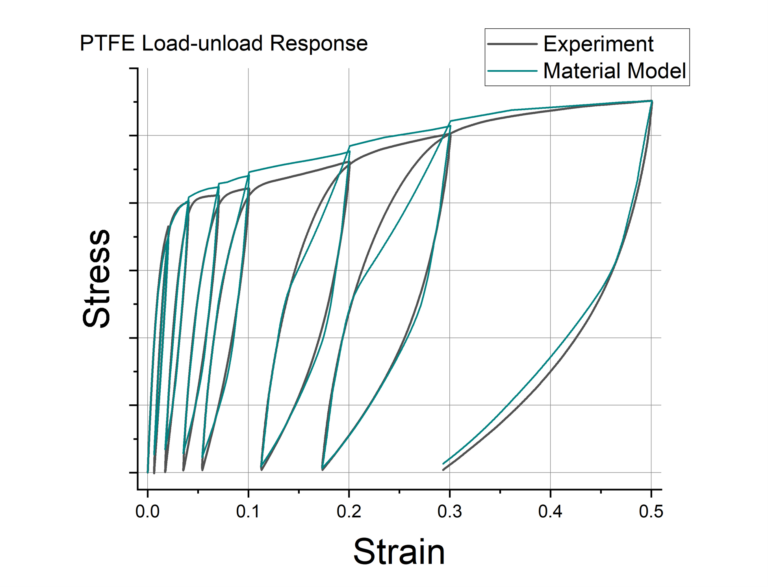
What about the bulk part of the hyperelastic material model?

The seal splits. The bushing cracks. The isolator is too stiff and fails to isolate. The bottle cap seal doesn’t seal.
Hyperelastic material models are often described as models that capture large strain behaviors. This is true. However, the other big thing that they handle is the incompressible nature of rubbery materials. A rubber disc freely compressed may feel soft and the measured stiffness may show it to be soft. However, that same rubber disk, when confined and compressed may be very stiff. It may be 500 to 1000 times stiffer! The graph above shows a black strain-stress curve of a confined silicone compressed compared to the same silicone material compressed sitting open on a test platen.
“So what?” you might say, my part isn’t confined like that. It’s a mount out in the open. Or perhaps it is a soft seal that is barely strained.
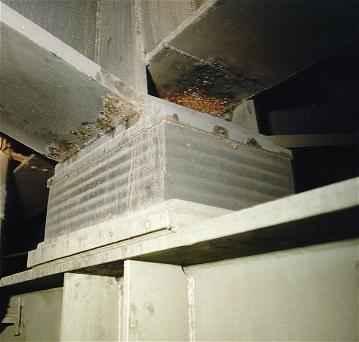
It does matter and it may matter a lot. Because the material is almost always constrained somewhere, the rubber that is constrained is acting more like the stiff black curve than the soft red curve. When rubber is bonded to a metal surface, rubber near the bond is very stiff. Civil engineers exploit this feature by increasing the amount of rubber near bonded metal. They add metal plates to increase the bonded surface area where the stiffness is high. Here is a metal bridge bearing that I see on my way into work. Notice the plates. With only one plate or no plates, the bridge support would be very soft.
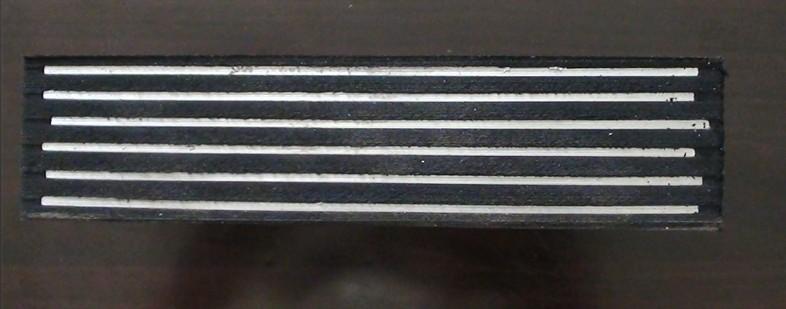
Now imagine an elastomeric seal inside a groove. The material and the geometry of the seal tend to make it soft initially. However, as the compression increases, the contact surface increases. If the material cannot move easily due to friction, the material at the surface if confined and the local stiffness increases. This may be a very desirable effect. However, if the seal fills the volume, the stiffness may increase by a factor of 500 to 1000! That is very hard to imagine because we think of the elastomer as soft. The elastomer may deform the contact surfaces or even flow out between hard surfaces.

Two common reasons for this kind of failure are:
- The part dimensional tolerances are not controlled and in some cases the seal is simply too large.
- Thermal expansion increases the size of the elastomer seal more than the size of the surrounding groove causing the seal to overfill the groove.
When nearly incompressible elastomeric materials are used, hyperelastic material models may be needed even if the overall deviatoric strains are small because of the bulk stiffness effects.