Material Model Calibration Services
On This Page:
Material Model Calibration Services
Axel Products provides testing services for engineers and analysts. In serving analysts and performing training with the major simulation software providers, we have developed the ability to make stable and descriptive material models for elastomers and some plastics.
We fit the material models that are native to the simulation tools. In some cases, we share the process and fit the material models in a collaborative way so that our customers can fit their own models to data sets in the future.
In general, our objective is to use the material model with the simplest math to describe the behaviors needed in the application. This results in a stable, accurate simulation. This may mean a simple Neo-Hookean material model to capture stiffness. Or, it may require a parallel rheological framework (PRF) model to capture softening, set and large strain dynamic effects.
Here are some examples of material modeling services at Axel.
Capturing Set and Plastic Behavior in Thermo-plastic Elastomers
Objective
A material model is needed to describe the stress distribution and the set in an elastomeric part during use.
Introduction
At Axel, we fit material models based on the needs of the simulation, the capabilities of the finite element software being used and the behavior of the material. In this case, the material will be compressed and somewhat confined in a metal housing. A hyperelastic model is selected to capture the incompressible material behavior during use to describe the complex strain field and predict the performance of the part. In addition, the application requires that we predict the plastic set in the part as well. In this case, the material does have significant set during in-use operations and the simulation software Abaqus supports the combination of plastic and hyperelastic material descriptions.
Testing and Modeling Effort
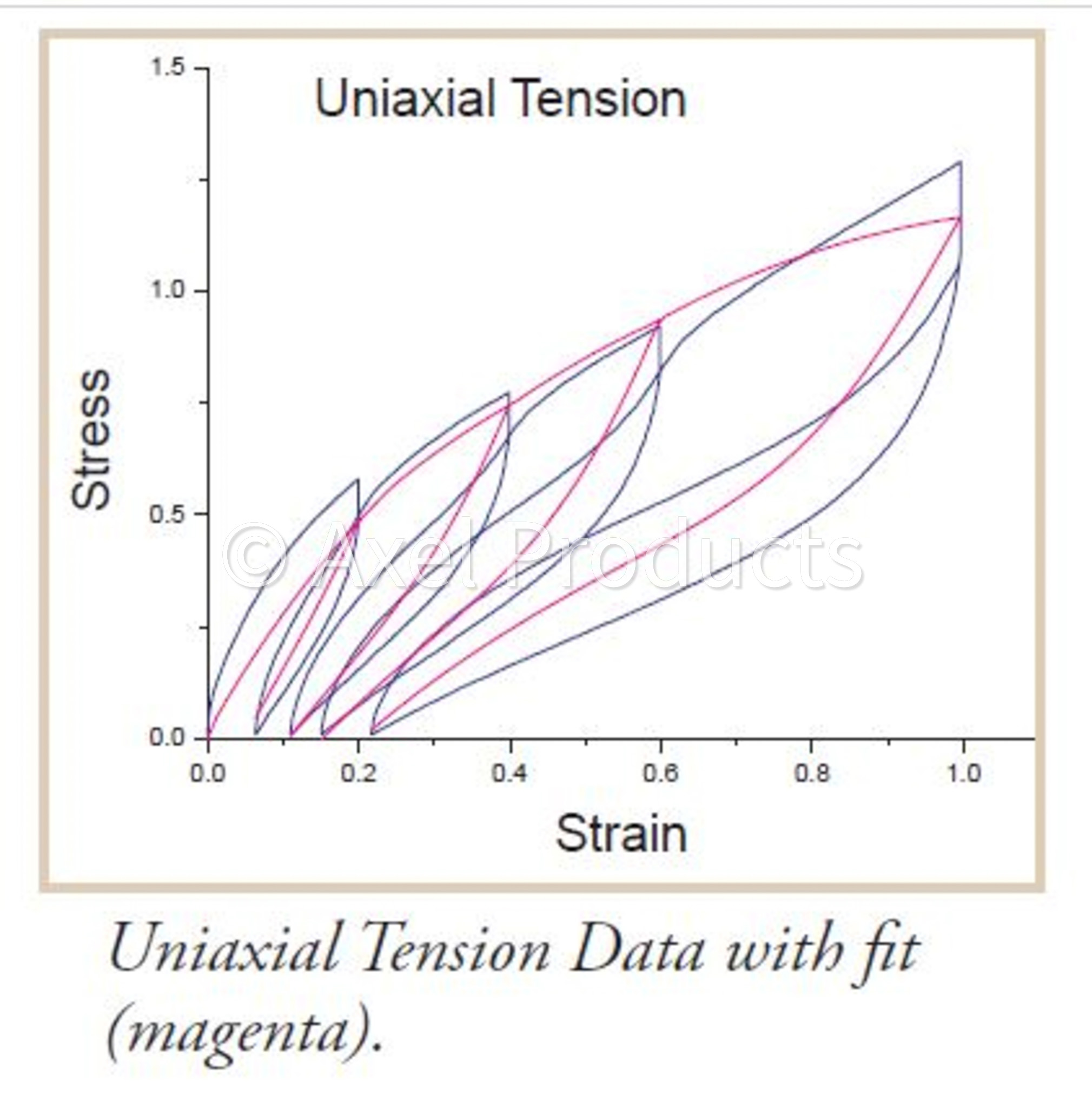
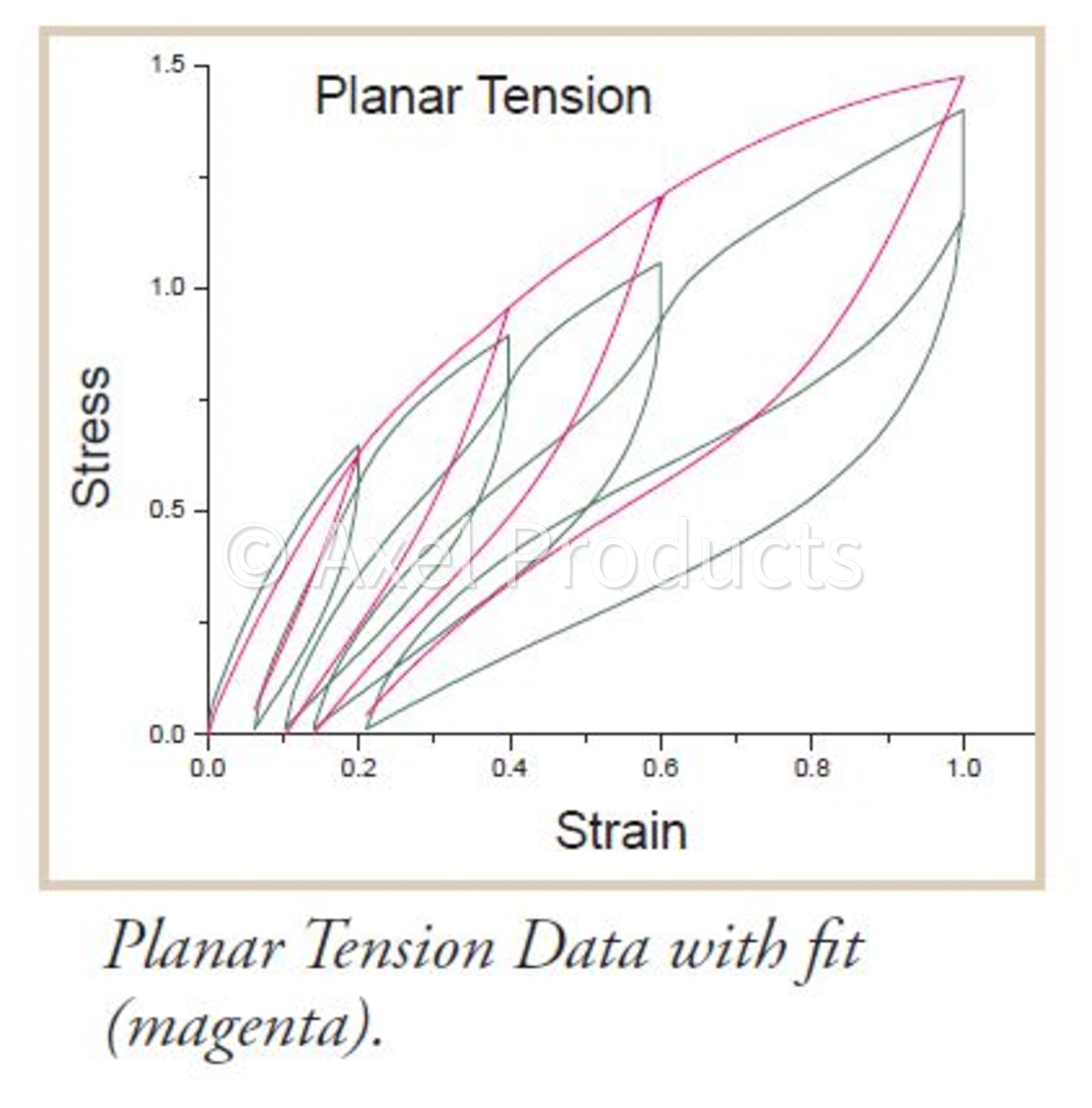
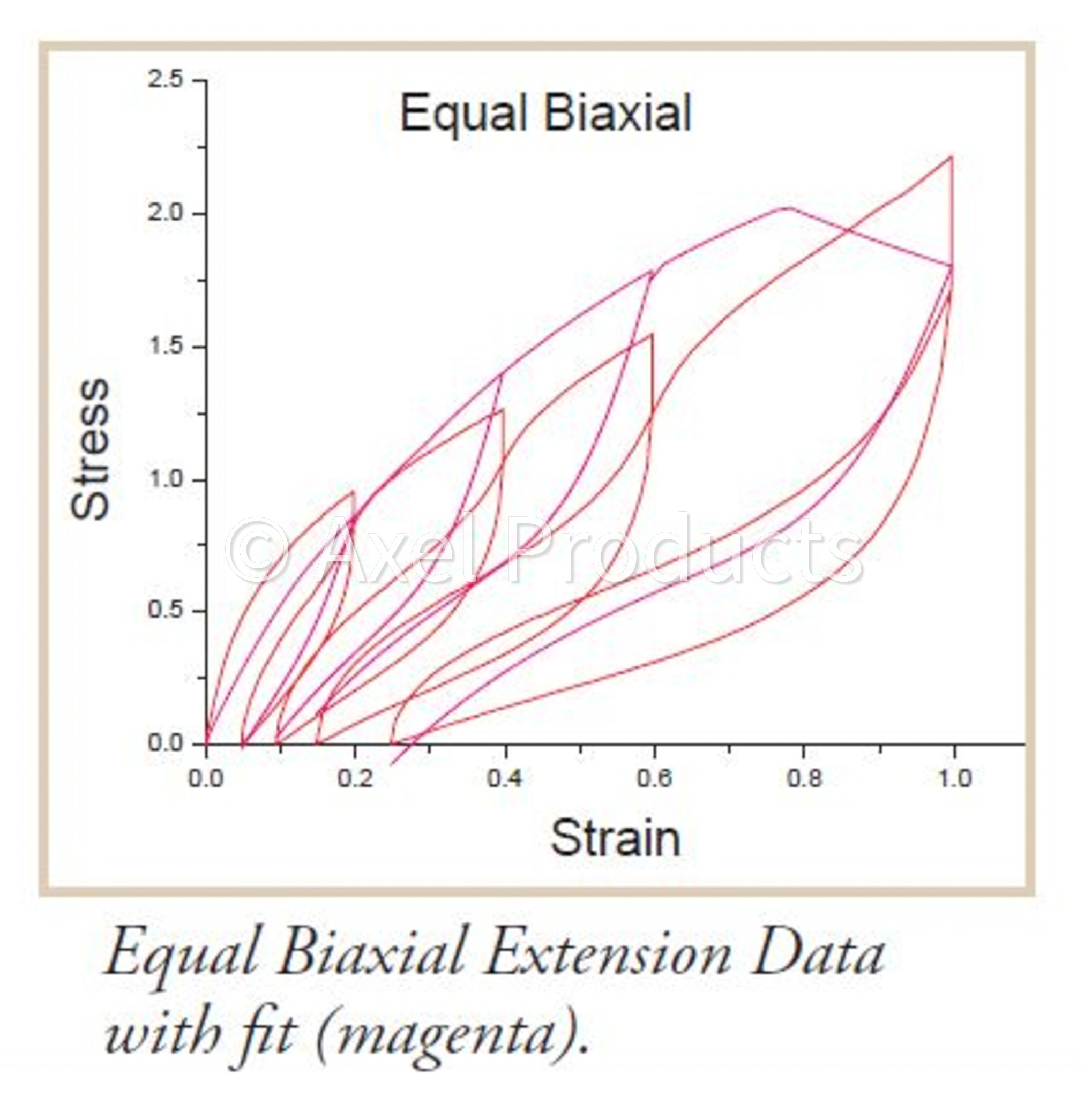
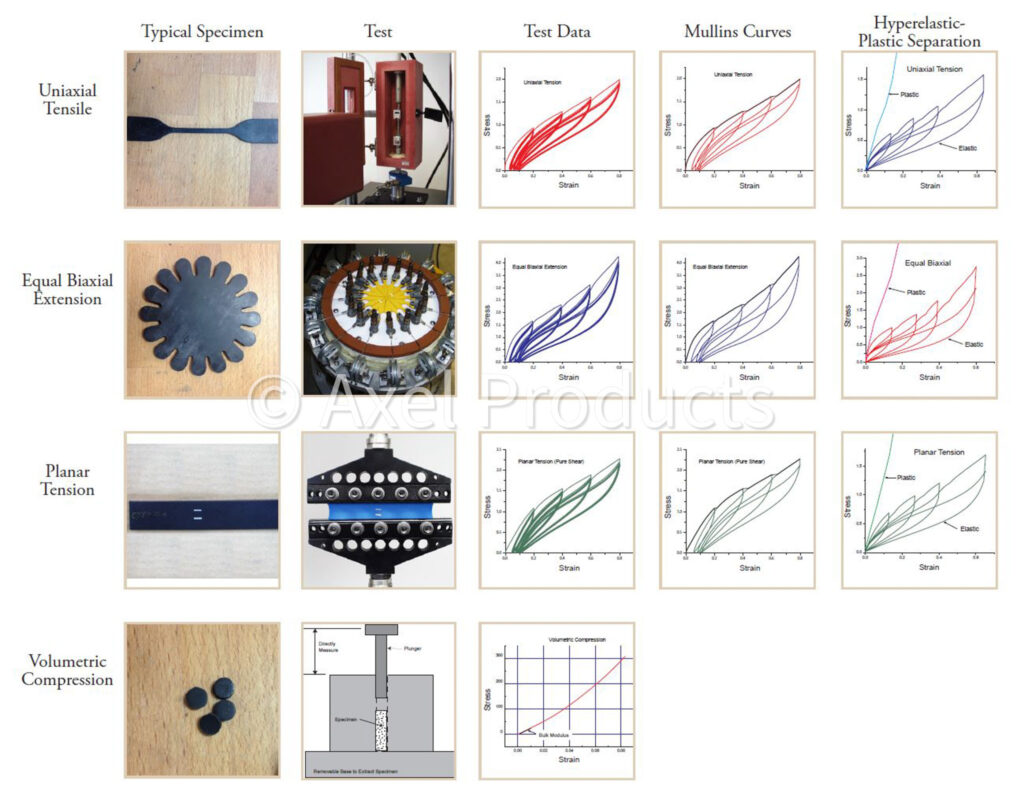
Physical experiments are performed in multiple strain states so that the calibrated hyperelastic model describes the material behavior during its complex deformation. Multiple models are reviewed and the simplest math model with the best fit is selected. The experiments run are the three classic experiments: uniaxial tension, planar tension (pure shear), and equal biaxial extension. Because the part will experience significant confinement, a volumetric experiment is performed to capture the bulk behavior. Uniaxial compression is avoided because of adverse friction effects during the experiment.
Fitting a Hyperelastic Material Model for Hyperelastic plus Softening
Objective
A material model is needed to describe the stress distribution and the set in an elastomeric part during use.
Introduction
At Axel, we fit material models based on the needs of the simulation, the capabilities of the finite element software being used and the behavior of the material. In this case, the material will be compressed and somewhat confined in a metal housing. A hyperelastic model is selected to capture the incompressible material behavior during use to describe the complex strain field and predict the performance of the part. In addition, the application requires that we predict the plastic set in the part as well. In this case, the material does have significant set during in-use operations and the simulation software Abaqus supports the combination of plastic and hyperelastic material descriptions.
Testing and Modeling Effort
Physical experiments are performed in multiple strain states so that the calibrated hyperelastic model describes the material behavior during its complex deformation. Multiple models are reviewed and the simplest math model with the best fit is selected. The experiments run are the three classic experiments: uniaxial tension, planar tension (pure shear), and equal biaxial extension. Because the part will experience significant confinement, a volumetric experiment is performed to capture the bulk behavior. Uniaxial compression is avoided because of adverse friction effects during the experiment.

Fitting an Elastomer First Time Loading
Objective
A material model is needed to describe the behavior of a thick elastomer seal during a factory installation operation.
Introduction
At Axel, we fit material models based on the needs of the application and the capabilities of the finite element software being used. In this case, the material will be compressed and somewhat confined between two mating metal pieces. A hyperelastic model is selected to capture the incompressible material behavior and the complex strain field during the structural loading.
Testing and Modeling Effort
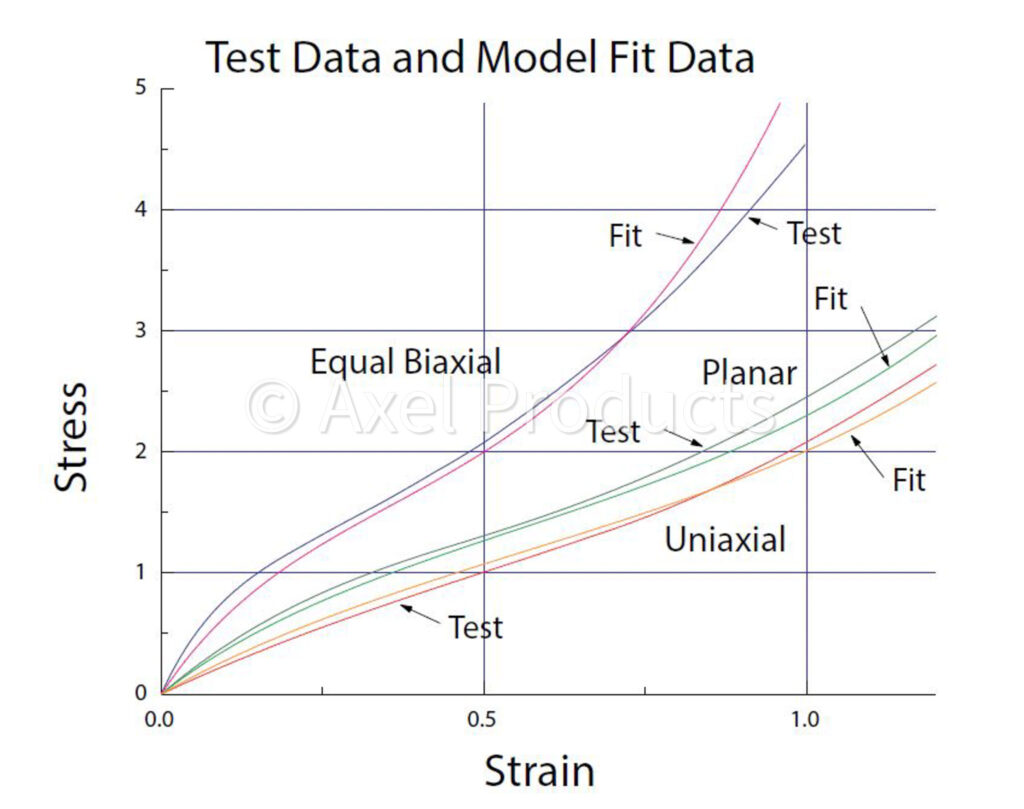
Physical experiments are performed in multiple strain states so that the calibrated hyperelastic model describes the material behavior during complex deformation. Multiple models are reviewed and the simplest math model with the best fit is selected. Models considered include Mooney-Rivlin, Neo-Hookean, Yeoh, Ogden, Gent, and Arruda-Boyce. The experiments run are the three classic experiments: uniaxial tension, planar tension (pure shear), and equal biaxial extension. Because the seal will experience significant confinement, a volumetric experiment is performed to capture the bulk behavior. Uniaxial compression is avoided because of adverse friction effects during the experiment. The material experiments were performed to high strains yet the application strains were not expected to exceed 50%. As such, the test data was truncated and the material model fitting was restricted to more realistic strains.
Combining Plastic and Hyperelastic Material Models to Describe PEEK Behavior
Objective
PEEK is the selected material in a bearing application where stresses are expected to cause plastic yielding.
Introduction
At Axel, we fit material models based on the needs of the simulation, the capabilities of the finite-element software being used, and the behavior of the material. In this case, the material will support loads and undergo some localized plastic deformation. It is important to predict the plastic deformation and the resulting deflections under loading. There isn’t a distinct yield point and the material has a changing loading slope with increasing strains. An isotropic plastic model with hyperelastic and Mullins softening is selected to capture the behavior.
Testing and Modeling Effort
Often for thermoplastic models only tensile test data is used to calibrate the material model. Because the material model is somewhat complex and the application has a complex stress distribution, tensile data, tensile load-unload data, shear data, and in-plane compression data were collected.
The tensile load-unload data to 2%, 5%, and 10% strain was used to make initial guesses for the isotropic plasticity parameters. A Yeoh model was selected using a hand-fitted modulus to guess at the first Yeoh term and the 2nd and 3rd parameters were made small. Mullins parameters were selected to make the Mullins effect small. We could have been more methodical about separating these effects and fitting them individually but the analyst was feeling lucky.
Capturing Large Strain Rate Sensitivity in a Material Model
Objective
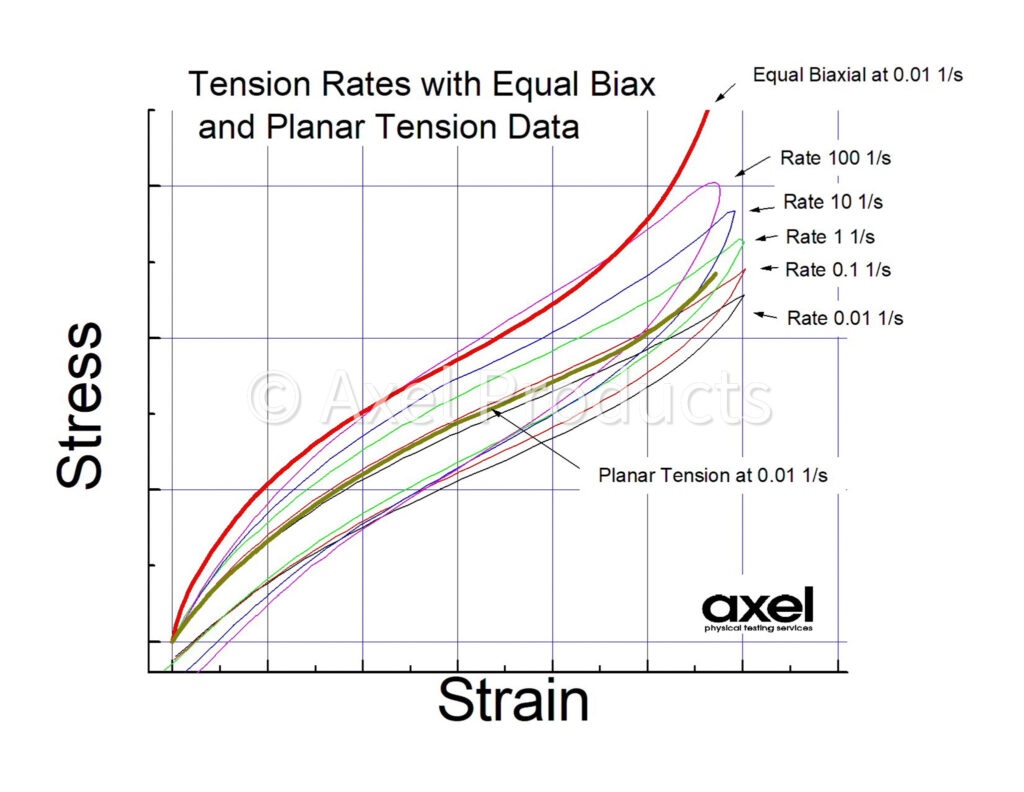
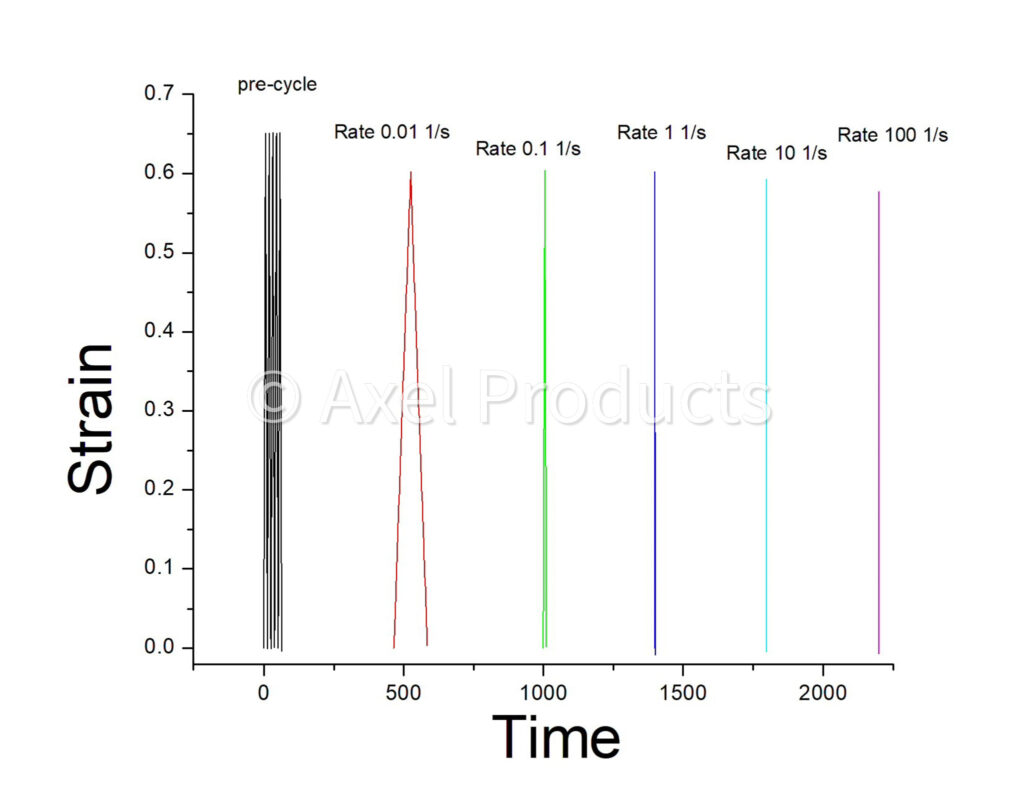
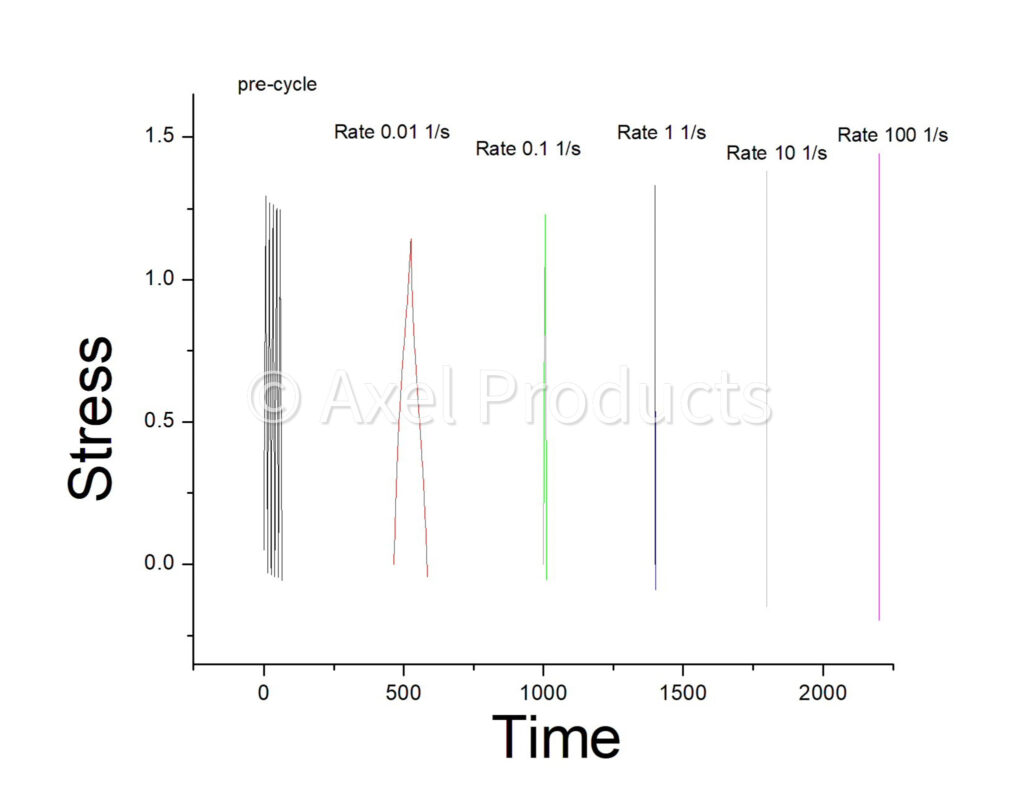
In this case, the objective is to characterize the strain rate sensitivity and hysteresis of a rubber subjected to large strains in service.
Introduction
This data would typically be used with other additional test data to characterize viscoelastic and hyperelastic material behaviors.
This approach minimizes the effects of plastic set and Mullins type softening while providing an efficient approach to measure large strain viscoelasticity.